nuevoMailer SB v.10.5

How to set up website autoresponders and email triggers

https://www.nuevomailer.com/email-auto-responders

Set up self-hosted website autoresponders that send the right follow-up at the right time, based on schedule or subscriber behavior.

  • Create time-based drip campaigns and behavior-based action triggers from one interface.
  • Install on your own server and connect to your website forms, CRM, ecommerce platform, or API.
  • Track each autoresponder email with detailed delivery, open, click, and conversion-ready reporting.

What are email autoresponders?

Email autoresponders are automated emails that are sent in a predefined sequence based on time, subscriber events, or date fields.
In practice, terms like drip campaigns, follow-up series, and autoresponder campaigns are often used for the same workflow.

How to set up an autoresponder on your website

  1. Create or choose a mailing list. Group subscribers by source, interests, product, intent, or anything you want.
  2. Connect subscriber sources. Add subscribers from forms, CSV files, API calls, CRM/CMS sync, shopping cart, or import from an external database.
  3. Create your first email and prepare a series of your next emails. Usually a welcome or onboarding message sent immediately after opt-in.
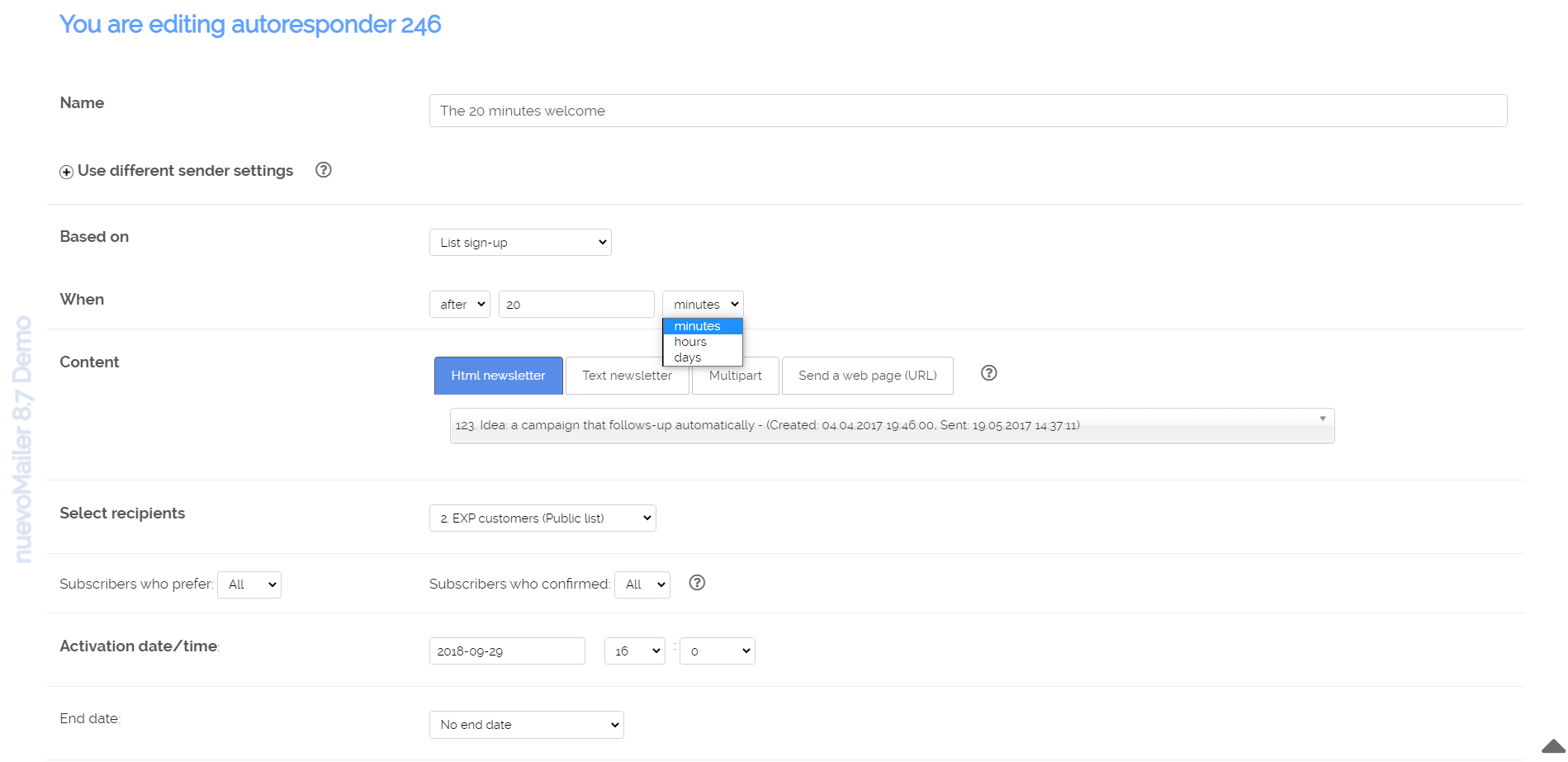
  4. Create autoresponders as a sequence. Such as 20 minutes, 1 day, 3 days, 7 days after sign-up (or other event).
  5. Add behavior triggers. Follow up based on open, click, list confirm, or specific hyperlink actions.
  6. Set exits and segmentation rules. Move engaged subscribers to a "warmer list" and reduce unnecessary sends.
  7. Test and launch. Send test data through forms/API, validate timing, then monitor performance.
Create a signup-based autoresponder workflow
Set up an autoresponder sequence after sign-up and control message timing.
Date based autoresponder with before and after options
Schedule emails before, on, or after subscriber date fields such as birthdays or appointments.

Common website autoresponder use cases

  • Welcome series: Send onboarding emails after a visitor subscribes through your website form.
  • Email course delivery: Release lessons over days or weeks automatically.
  • Post-purchase follow-up: Send onboarding, cross-sell, or support reminders after a customer buys.
  • Date reminders: Trigger appointment, anniversary, renewal, or birthday emails.
  • Re-engagement: Follow up with subscribers that have no opens or clicks for a period. See Subscriber re-engagement

Three practical implementation examples

An online educator captures sign-ups via landing pages and sends a 6-part onboarding series over 3 weeks. Subscribers who click lesson links are automatically moved to an advanced list for higher-intent offers.
A local beauty business syncs CRM appointment data nightly, stores the next-visit date in a custom subscriber field, and sends reminder emails one week and two days before each visit.
A cooking website offers a collection of premium tutorials, recipes, and expert guidance. Every time a purchase is completed, the customer’s details flow seamlessly into Zapier, which uses the nuevoMailer Zapier app to create a new subscriber and place them into a targeted mailing list. From there, a curated six‑part autoresponder series kicks in—delivering valuable content week after week to build engagement, trust, and long‑term customer loyalty.

Action triggers

Action triggers follow an action-and-reaction model. You define subscriber actions and the system executes your chosen reaction.

Available actions

  • Campaign or autoresponder open/click
  • Campaign or autoresponder email sent
  • Newsletter open/click
  • Specific hyperlink click
  • List opt-in
  • List confirm (double opt-in confirmation)

Available reactions

  • Send a follow-up email or newsletter
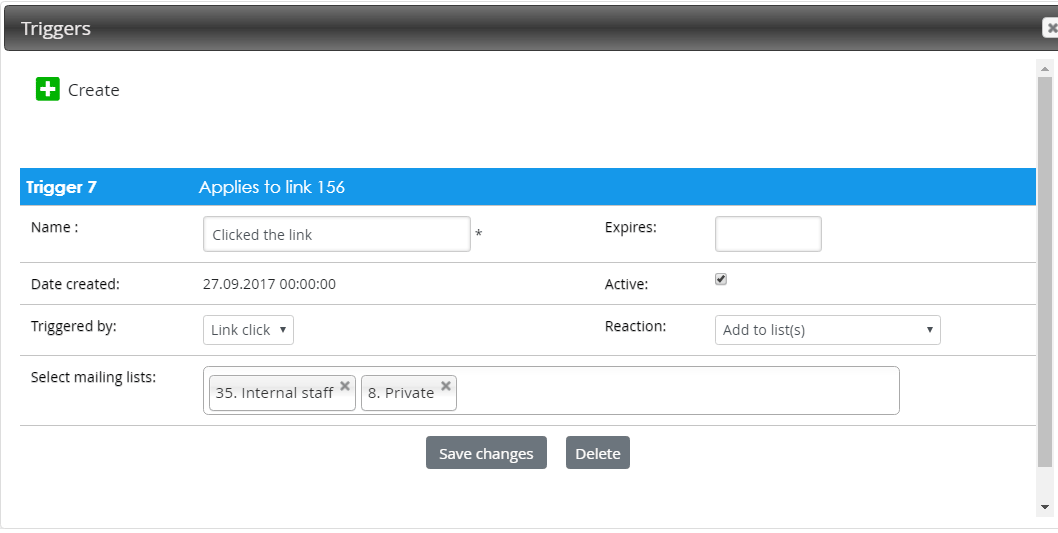
  • Add or remove subscriber from lists
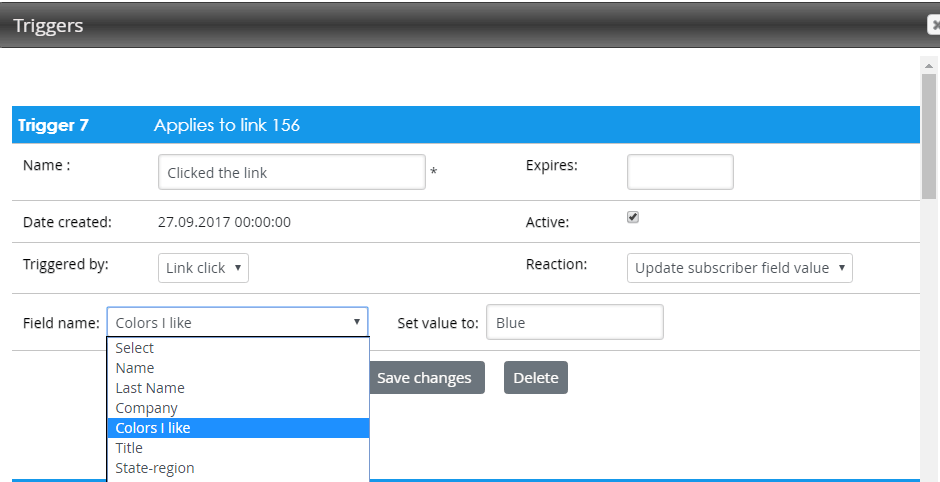
  • Update a subscriber field
  • Tag or un-tag subscriber
  • Execute outbound webhooks
  • Any combination of all the above

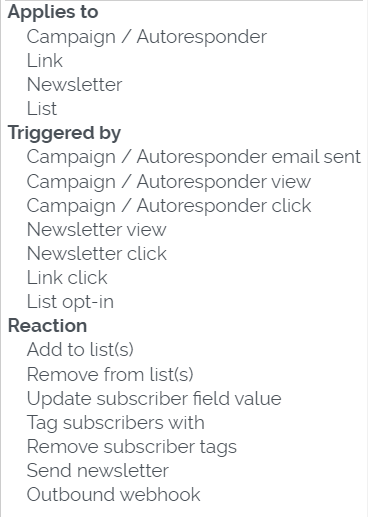
Trigger options

Trigger options matrix for actions and reactions
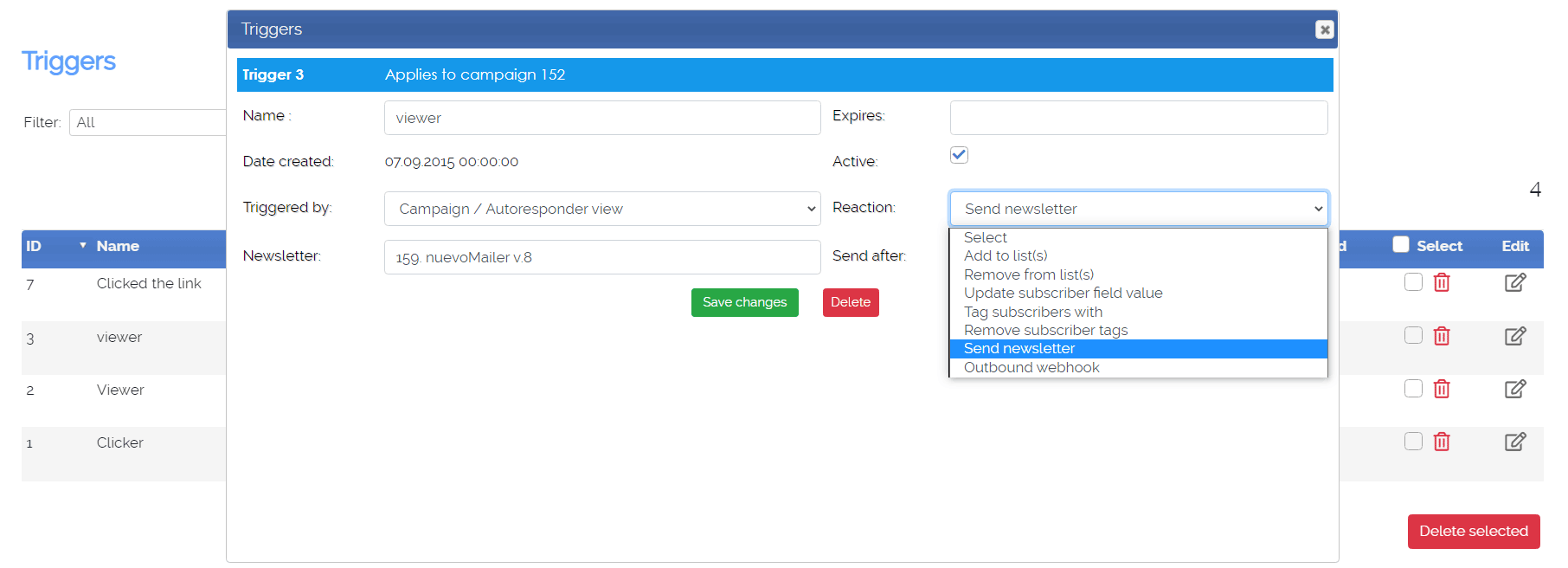
Following-up with an email trigger.
Following-up with a single email trigger upon Campaign-View/Open
Setting triggers
You can set triggers for all types of campaigns (incl autoresponders), newsletters, list and hyperlinks
Mailing lists
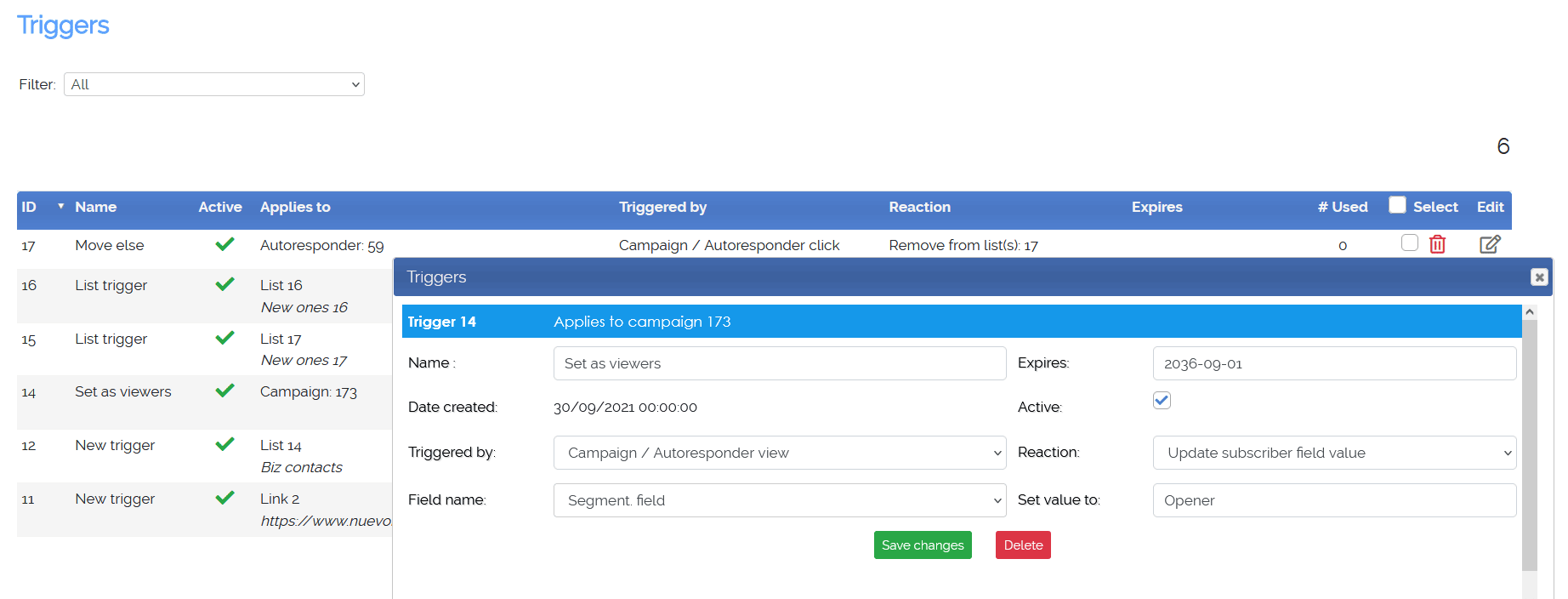
Campaign trigger that updates a subscriber field

Trigger options in detail

Reactions=>
Actions
Update subscriber field
Tag / Un-tag subscriber
Send a newsletter
(email trigger)
Add to / Remove from list(s) Execute an outbound webhook Applies to
On campaign/autoresponder open/click Specific campaign or autoresponder.
On campaign/autoresponder email sent Specific campaign or autoresponder.
On specific hyperlink Any newsletter or campaign where this link is clicked.
On newsletter open/click A specific newsletter across campaigns that use that newsletter. For any hyperlink of this newsletter.
On list confirm
After clicking the confirmation link
Triggered when subscribers click the confirmation link for sender profiles with double opt-in enabled.
On list opt-in
Opt-in forms & api
Opt-ins using forms & opt-ins using the api.
For triggering emails based on list sign-up date you can alternatively do it with an autoresponder campaign. See next option.
Using sign-up date or any subscriber date field - ✓ By creating autoresponder campaigns. - - Ideal for reminders, anniversaries, renewals, and appointment flows.
Email and newsletter "opens" are captured when images are allowed to load in the subscriber's email client.

Best practices for higher engagement

  • Start with a clear goal per sequence: onboarding, activation, retention, or re-engagement.
  • Keep delays realistic and avoid sending too frequently to cold subscribers.
  • Use segmentation and tags so follow-up emails match actual subscriber intent.
  • Do not duplicate trigger logic at both newsletter and campaign level unless needed.
  • Review reporting metrics and improve subject lines, timing, and content every cycle.

A couple of implementation ideas

Idea 1: Segment automatically with click intent

  1. Using the form builder to create a website opt-in form and place subscribers into a starter list.
  2. Set up autoresponder based on list sign-up time: 20 minutes, 1 day, 3 days, 7 days.
  3. Add a trigger on key links in each email.
  4. When subscribers click, move them to a warmer list and continue with targeted offers.

Idea 2: Build an engagement-driven drip flow

This is a more selective, focused and targeted way of drip email marketing. Where every next email depends on the subscriber's engagement.

  1. Send a welcome email immediately after opt-in.
  2. If the subscriber opens or clicks, trigger the next email. You will create email triggers on all the newsletters you plan to use. Clicked? Opened? Send another newsletter. Clicked again? Continue following up.
  3. If no engagement occurs, send a softer reminder after a longer delay.
  4. Stop the sequence or switch list when the subscriber reaches your conversion action.
  5. Final enhancement: create an autoresponder for this list to be sent several days later having a filter like "without clicks in the last X days".

FAQ

What is an email autoresponder?

An email autoresponder is a sequence of automated emails sent based on time delays, list sign-up, or subscriber activity.

How do I set up an autoresponder on my website?

Create a list, connect an opt-in form or API source, add a welcome email, define delays, add triggers, test, and monitor results.

Can I trigger emails based on clicks and opens?

Yes. You can trigger follow-up emails and list actions when subscribers open campaigns, click links, confirm subscriptions, or match date rules.

Can I run date-based autoresponders like birthday reminders?

Yes. You can use date fields or sign-up dates to schedule emails before, on, or after a specific date.

What is the difference between autoresponders and triggers?

Autoresponders are usually time- or date-based sequences. Triggers are event-based reactions to behavior such as opens, clicks, or list actions.

Can I set up autoresponders for website forms and API sign-ups?

Yes. You can start sequences from form opt-ins, API calls, CRM sync imports, and external database synchronization.

Can I exclude manually imported subscribers from automated flows?

Yes. It's just a checkbox to check.

Can I monitor who received and clicked each autoresponder email?

Yes. Autoresponders provide the same reporting and analytics just as your regular campaigns.
nuevoMailer SB v.10.5
USD 139.00 179.00 € £

See also,

Top of page