When is the best time to send emails?
What is send-time optimization?
Send-time optimization is a method used in email marketing that determines the optimal timing to send emails to each recipient.
This is done by collecting data from subscribers clicks and opens and calculating the best time-frame when most clicks or opens occur.
Who should use send-time optimization?
Send-time optimization is particularly interesting for those targeting an international audience or having subscribers located in different time zones.
Should also be considered when subscriber demographics and other traits are mixed.
What are the benefits in using send-time optimization?
Send-time optimization in email marketing has several benefits:
- Increased open rates: by sending your emails at the optimal time, when your audience is most likely to be checking their inbox, you can significantly increase your email open rates.
- Improved click-through rates: if more people are opening your emails, it's likely that more people are also clicking on the links within them. This can lead to higher engagement and conversion rates.
- Better customer engagement: by reaching your audience at the right time, you're more likely to engage them effectively. This can lead to better customer relationships and loyalty.
- Avoids overcrowding: by optimizing send times, you can avoid having your email lost in a crowded inbox. This can increase the visibility of your email and the likelihood it will be read.
- Personalization: send time optimization allows you to cater to the specific habits and preferences of your audience. This level of personalization can improve the overall effectiveness of your email marketing campaign.
- Reduced opt-outs: how many times have you instantly deleted an email because you were overwhelmed? When your email reaches the recipient at a time when he is most likely to engage you diminish the chances of a (rapid, frustrated) click on the opt-out link.
- Increased ROI: all of these benefits contribute to a higher return on investment for your email marketing efforts. By ensuring your emails are sent at the optimal time, you can get the most out of your email campaigns.
.... brands that Oracle Marketing Cloud Consulting has worked with, optimizing the best time to send emails results in an average lift in engagement of 10%-12% and an average lift in conversions of 5%-7%. Source
How nuevoMailer can help you?
- nuevoMailer is the first (and perhaps the only) self-hosted, on-premises deployed email marketing solution that offers send-time optimization since v. 10.0.
- This is achieved with the use of the multi-threaded sending plugin.
- You can still collect relevant timing data without the plugin but eventually you will need the plugin in order to send your campaigns using send-time optimization.
You can read more about how it works in the online help.
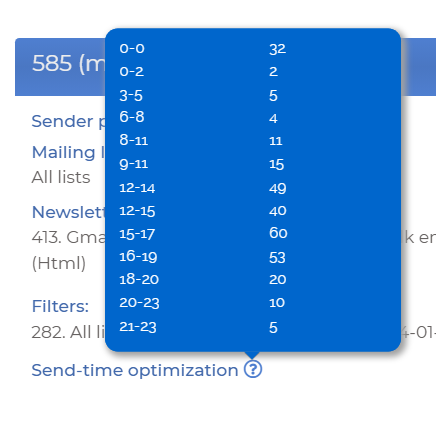
Here is an example of using send-time optimization
The left column refers to hours. The right column shows the number of emails that will be sent in each time frame.



 Products
 .com
.com